Physical Desktop
Making digital systems accessible through tangible objects
Durrell BishopSummary
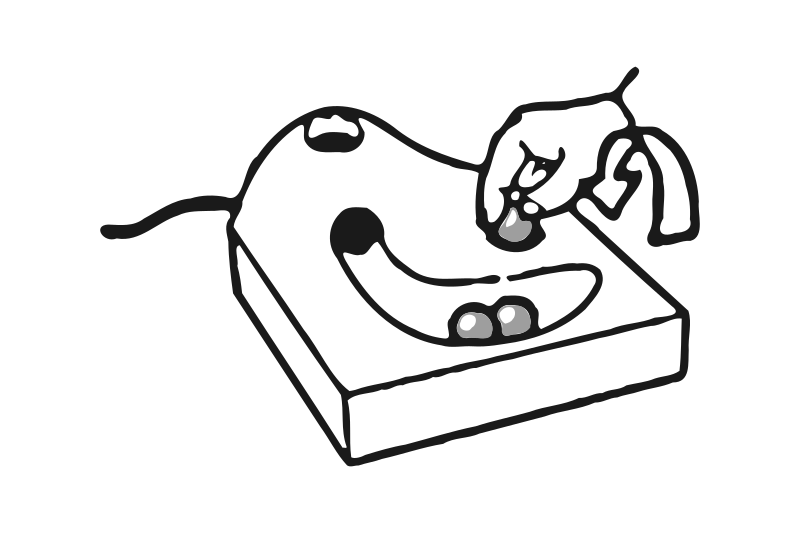
Durrell Bishop’s Physical Desktop reimagines the graphical desktop interface as a collection of physical objects distributed across a table. Developed during his second MA in Computer Related Design at the Royal College of Art in the early 1990s, the project proposed a new way of interacting with digital systems by representing files, people, and messages through tangible objects rather than screen-based icons. The concept builds on his earlier Marble Answering Machine (1992), extending the idea of representing digital information through physical tokens.
In this system, each object embodies a piece of digital information or a relationship. For example, a physical token representing a friend could be used to call them, filter their emails, or open their folder on a computer to exchange files. These objects interact with a set of tools — such as a phone, speaker, microphone, or screen — which allow users to access or add digital content simply by bringing the object into contact with the device.
The tabletop environment functions as an ecology of active devices and objects. Items like marbles can represent voice messages, while other tokens might represent people, folders, or collections of information. Each object acts both as a representation of digital data and as a control mechanism for interacting with it, allowing users to manipulate information through familiar physical actions.
By translating abstract digital concepts into tangible forms, Bishop’s work explores how the physical world can provide intuitive structures for interacting with complex computational systems.
If a recognizable physical object has a pointer to a window or folder, some form of container in a computer space, then perhaps the physical environment is just as real as the screen environment; in fact, they are one and the same thing. Any object picked up physically, which you can see has been augmented with additional information, can be taken to a tool, perhaps a reader, or to a screen, and you can see the same object in its other representation; the screen is only another representation.

Key concepts
- Tangible computing A design approach where digital information and functions are represented through physical objects, allowing users to interact with computational systems through natural gestures and spatial relationships.
- Ecology of active devices The system consists of interconnected tools — such as phones, speakers, microphones, and screens — that respond differently when a physical object is placed near them, enabling multiple interactions with the same piece of information.
- Self-descriptive objects Physical forms communicate their purpose through shape, behavior, and context. Unlike abstract buttons or icons, tangible objects can embody meaning through their material properties and interactions.
- Physical pointers to digital information Objects act as tangible references to digital files, contacts, or ideas. When brought to different tools, they reveal or activate the associated digital content.
The Physical Desktop challenges the dominance of screen-based interfaces by proposing a world where digital systems are represented through physical objects and environments. By harnessing the intuitive qualities of tangible tools and spatial interaction, Bishop’s work demonstrates how computation can become more accessible, memorable, and socially meaningful. The project foreshadows a future in which digital information is embedded within everyday objects, enabling people to understand and manipulate complex systems through the same physical intuition they use to navigate the world around them.
This idea was originally published as Physical Desktop. Further discussion of this project and Bishop’s approach to tangible computing can be found in Adventures in Tangible Computing by Rachel D. Abrams and Designing Interactions by Bill Moggridge, both of which feature interviews with Bishop about this work.
Big Idea Initiative is all about making connections, and sharing knowledge, thoughts, and ideas that support deep thinking and collaboration. Our goal is to create a space that sparks thinking and conversations among people whose ideas might benefit each other, even if they’re working on completely unrelated topics. We think that pushing back the limits of possibility will come as a result of the connections that diverse collaborators make together. Identifying these connections will bring the big ideas our world needs.
We need your help! If you…
- have questions or feedback about this work
- want to improve, develop, or add to this idea
- want to sponsor a prototype of this idea
we invite you to contact us: hello@bigideainitiative.org.