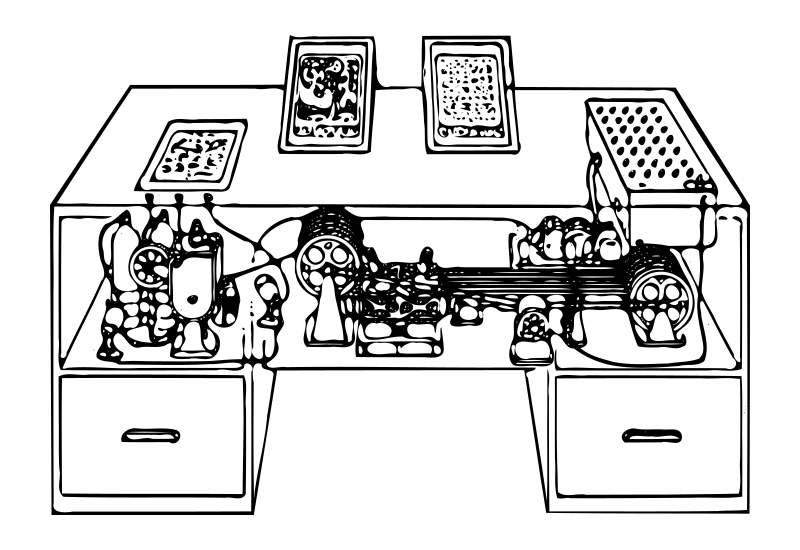
Sketchpad
A man-machine graphical communication system
Ivan SutherlandSummary
Sketchpad, developed by Ivan Sutherland in the early 1960s as part of his PhD dissertation at MIT, stands as one of the most influential computer programs in history — pioneering ideas that shape how computers are used today. It introduced an interactive graphical system where users could draw directly on the screen using a light pen, pointing to and manipulating objects visually rather than through text commands. This direct-manipulation interface anticipated fundamental interaction conventions such as selecting objects by clicking them and dragging to transform them — conventions that remain central to modern graphical user interfaces.
Sutherland’s original ambition was far more expansive than just drawing on a screen: he sought to dissolve the strict division between users and programmers by empowering new classes of people — artists, designers, engineers — to engage with computation directly, without needing traditional programming abstractions. Although later interfaces simplified abstraction by hiding it from users rather than exposing it in intuitive ways, Sketchpad’s design was an early and profound exploration of how interactive systems could embed computational structure in what the user sees and does.
The ideas first articulated in Sketchpad were circulated widely through Sutherland’s dissertation, a demonstration film, and a widely cited conference paper. Decades later, its influence persists in everything from windowed environments to CAD systems to the very concept of direct manipulation, reminding us that computing can be a medium for expression and exploration, not just a tool for execution.
The decision actually to implement a drawing system reflected our feeling that knowledge of the facilities which would prove useful could only be obtained by actually trying them. The decision actually to implement a drawing system did not mean, however, that brute force techniques were to be used to computerize ordinary drafting tools; it was implicit in the research nature of the work that simple new facilities should be discovered which, when implemented, should be useful in a wide range of applications, preferably including some unforeseen ones. It has turned out that the properties of a computer drawing are entirely different from a paper drawing not only because of the accuracy, ease of drawing, and speed of erasing provided by the computer, but also primarily because of the ability to move drawing parts around on a computer drawing without the need to erase them. Had a working system not been developed, our thinking would have been too strongly influenced by a lifetime of drawing on paper to discover many of the useful services that the computer can provide.
Key concepts
- Direct manipulation interface Users interact with visible objects directly via a light pen, pointing, selecting, and dragging shapes on the screen — establishing the core interaction model for modern graphical user interfaces.
- Structural graphics & constraint programming Sketchpad introduced constraint-based relationships between graphical elements (such as perpendicularity, equal length, or fixed angles), allowing users to specify what must remain true while freely manipulating the drawing. This enabled mathematical precision to coexist with intuitive, sketch-like input.
- Master/instance inheritance Users could define a “master” drawing and create multiple instances from it. When the master was updated, its instances updated automatically, introducing an inheritance model for graphical objects.
- Hierarchical composition Complex objects could be built from simpler ones by nesting instances within instances, forming hierarchical structures that supported reuse, abstraction, and scalable complexity.
- Bridging users and programmers Sketchpad sought to erase the boundary between end users and programmers by embedding abstraction directly into interaction, allowing people to work with structure, rules, and behavior through visible manipulation.
Sketchpad marks a turning point in human-computer interaction, treating the computer screen as a responsive medium rather than a passive output device. By letting people point, draw, and manipulate graphics directly, it laid the conceptual foundations for the graphical interfaces we take for granted today and challenged designers to think of computers as environments for expression, not just calculation. Sketchpad’s lasting power comes from its use of constraint-based programming as an interaction technique: users could sketch freely and then refine their drawings with mathematical precision, or specify relationships to be maintained while continuing to interact visually. By removing the rigid distinction between input and output — between drawing and computation — Sketchpad enabled a richer dialogue between person and computer, one where intuition and abstraction reinforce rather than compete.
This idea was originally published as Sketchpad: A man-machine graphical communication system.
Big Idea Initiative is all about making connections, and sharing knowledge, thoughts, and ideas that support deep thinking and collaboration. Our goal is to create a space that sparks thinking and conversations among people whose ideas might benefit each other, even if they’re working on completely unrelated topics. We think that pushing back the limits of possibility will come as a result of the connections that diverse collaborators make together. Identifying these connections will bring the big ideas our world needs.
We need your help! If you…
- have questions or feedback about this work
- want to improve, develop, or add to this idea
- want to sponsor a prototype of this idea
we invite you to contact us: hello@bigideainitiative.org.