Xanadu
A vision for a universal, deeply linked, and permanent hypertext system
Ted NelsonSummary
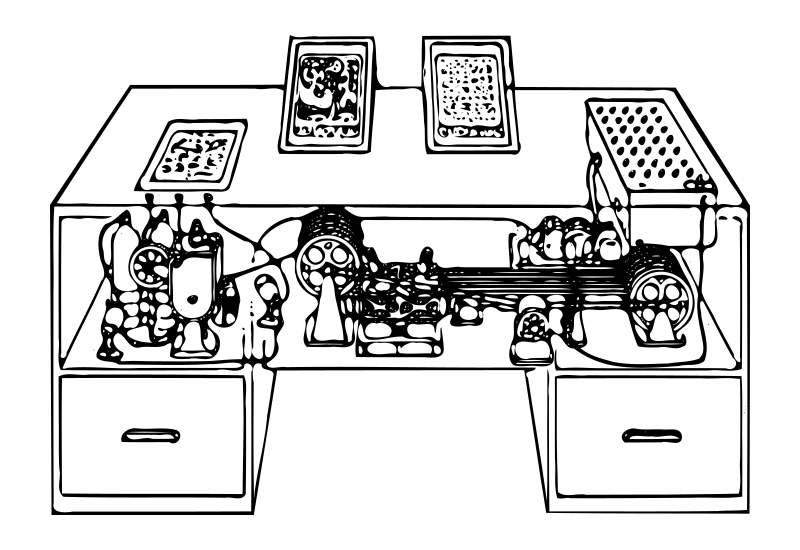
Project Xanadu was Ted Nelson’s ambitious vision for a universal hypertext system — a global publishing network where documents are deeply interlinked, permanently addressable, and financially sustainable. Conceived in the 1960s, Xanadu sought to realize and extend Vannevar Bush’s Memex idea into a shared, networked information system.
Unlike the later World Wide Web, Xanadu emphasized bidirectional links, transclusion (the inclusion of portions of one document inside another without duplication), and permanent versioning. Every document would remain available forever, with changes tracked over time. Links would never break, and authors would automatically receive credit and micropayments when their work was referenced or reused.
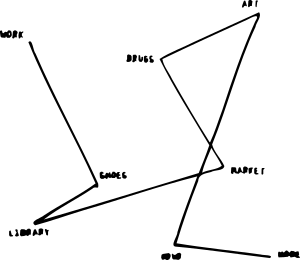
At its core, Xanadu treated writing not as static pages but as a fluid, interconnected fabric of ideas. Documents could quote one another dynamically; readers could trace connections, compare versions, and see exactly how texts related. Nelson imagined a “docuverse” — a unified, deeply structured body of human knowledge — where information was richly connected rather than siloed.
It is my belief that this new ability to represent ideas in the fullness of their interconnections will lead to easier and better writing, easier and better learning, and a far greater ability to share and communicate the interconnections among tomorrow’s ideas and problems. Hypertext can represent all the interconnections an author can think of; and compound hypertext can represent all the interconnections many authors can think of.
Key concepts
- Bidirectional linking Links in Xanadu were two-way by design. If document A linked to document B, document B would automatically show that it was being referenced, creating a transparent web of relationships.
- Transclusion Instead of copying text, Xanadu allowed documents to include portions of other documents by reference. The original source remained intact, ensuring attribution and version integrity.
- Persistent versioning No document was ever overwritten or deleted. Every change created a new version, preserving the full history of ideas over time.
- Micropayments & attribution Xanadu proposed automatic compensation for authors when their work was reused, embedding rights management directly into the system architecture.
- The docuverse Nelson’s term for a universal, interconnected library of all written knowledge — navigable, structured, and permanently addressable.
Project Xanadu represents one of the most ambitious attempts to rethink publishing, authorship, and knowledge in the digital age. Where the Web optimized for simplicity and rapid adoption, Xanadu pursued structural rigor, permanence, and fairness. It imagined a world in which ideas remain connected, traceable, and economically sustainable — a world where digital writing is not disposable, but part of a carefully woven and enduring intellectual fabric.
This idea was originally conceived as Project Xanadu. It was documented across Ted Nelson’s writings and talks, most notably in Literary Machines, Computer Lib/Dream Machines, and Replacing the Printed Word.
Big Idea Initiative is all about making connections, and sharing knowledge, thoughts, and ideas that support deep thinking and collaboration. Our goal is to create a space that sparks thinking and conversations among people whose ideas might benefit each other, even if they’re working on completely unrelated topics. We think that pushing back the limits of possibility will come as a result of the connections that diverse collaborators make together. Identifying these connections will bring the big ideas our world needs.
We need your help! If you…
- have questions or feedback about this work
- want to improve, develop, or add to this idea
- want to sponsor a prototype of this idea
we invite you to contact us: hello@bigideainitiative.org.